



 Share on ChatGPT
 Share on Grok
Gasoline averaged a record $4.33 a gallon in September 2026 and stood at $4.41 on October 1, while residential electricity rose only about 5% over the same year. What you pay to charge a Tesla comes down to four things: your Tesla model, your local electricity rate, where you plug in, and what time you do it. This article breaks down real 2026 numbers for charging at home, at a Supercharger, and on pure sunshine.
Quick answer:
A full home charge costs 13–25 depending on your model, about 4–8¢ per mile. At the AAA national average of $4.41 a gallon, that is about a third or less of what a comparable gas car costs per mile.
Key takeaways
- Home charging: 13–25 per full charge, depending on model and local electricity rates
- Annual savings vs. gas: 1,200–2,000 a year, because gasoline is up about 40% year over year while electricity is up about 5%
- Solar charging: brings the effective cost down to roughly 6–11 per full charge, even without the federal tax credit
- Public charging: Tesla owners typically pay about $0.43/kWh at Supercharger peak rates, 2–3x home rates; off-peak pricing narrows the gap
- Supercharger membership: the $12.99/month membership is for non-Tesla EVs; Tesla owners get member pricing automatically
- Limited-time offers: Tesla runs free-Supercharging and financing promotions on new orders from time to time, so check tesla.com for whatever is current when you order
2026 at a glance
≈40% vs ≈5%
How much more gasoline costs than a year ago, compared with the rise in residential electricity prices over the same period. That gap is why the cost of driving a Tesla has pulled further ahead of gas.
How Much Does It Cost to Charge a Tesla?
Home charging is still the cheapest and easiest option: plug in overnight, wake up to a full battery. The costs below assume $0.18/kWh, in line with the EIA's 2026 forecast for the U.S. residential average, and a real-world charging efficiency of about 90%. For comparison, the U.S. Department of Energy notes that a gasoline vehicle converts only about 12–30% of the energy in its fuel to power at the wheels.
Based on $0.18/kWh and 90% charging efficiency. Energy use comes from EPA ratings, converted from MPGe at 33.7 kWh per gallon-equivalent. Tesla doesn't publish exact pack capacities, so battery sizes are directional estimates and full-charge costs are calculated from them.
4.4¢ per mile
What it costs to drive the most efficient Tesla trims on home electricity at $0.18/kWh. The same mile in a 30-mpg gas car costs about 14.7¢ at $4.41 a gallon.
Driving 13,500 miles a year in a Model Y Premium costs roughly 610–700 in electricity, about 51–58 a month. Smart charging habits push that even lower:
- Charge overnight (9 PM–6 AM) instead of during peak demand hours
- Enroll in a time-of-use electricity plan for 30–50% savings
- Let Tesla's built-in scheduler pick the cheapest hours automatically
Expect your electricity bill to rise by roughly 45–80 a month (based on 1,000 miles of driving) while your gas station visits drop to zero. That is a solid trade against the 200–225 a month a driver of a 22–25 mpg vehicle spends on gasoline at $4.41 a gallon (13,500 miles a year).
Model Y L
The six-seat Model Y L launched in the U.S. on July 2, 2026, with deliveries beginning in September and an EPA-estimated range of 325 miles. If its efficiency matches the Model Y Premium AWD (28.8 kWh/100 mi), a full charge from empty costs about $17 at $0.18/kWh, or roughly 5.2¢ per mile.
Home Charging Setup Costs
Not free, but a one-time cost that pays for itself fast:
*Tesla adjusts this price often; check shop.tesla.com for the current rate. The federal credit for installed charging equipment applied only to property placed in service by June 30, 2026, so look to state and utility rebates for help with installation costs.
Tesla Charging Costs by Model Breakdown
Each Tesla model has a different efficiency and battery capacity, and both feed directly into your charging costs.
- Model 3 and Model Y are the cheapest to run, at roughly 4.4–5.8¢ per mile. The Model Y matches the Model 3's efficiency despite the extra SUV space, thanks to better aerodynamics and heat-pump technology. The base dual-motor Model Y AWD and the Performance trims run a bit higher per mile.
- Cybertruck has a 123 kWh pack, the largest in the lineup, and a full charge costs 24–25. At 7.7¢ per mile it is still only about a third of the per-mile cost of a comparable gas pickup, which runs 22–24.5¢ at $4.41 a gallon.
Model S and Model X (legacy models)
Tesla ended Model S and Model X production in the second quarter of 2026, but both remain a common sight on the road. Their ~100 kWh batteries cost more per charge than a Model 3 or Model Y and deliver extended range for fewer stops on road trips.
Based on $0.18/kWh and 90% charging efficiency.
Public Charging Station Costs
Public charging costs roughly 2–3 times more than home charging, with prices varying by location, network, and time of day. The U.S. average across public EV charging stations is 42¢ per kWh.
Tesla Supercharger
Tesla doesn't publish one fixed nationwide price. Supercharger rates are dynamic, set per site and time of day. The table shows typical peak rates across the U.S. in mid-2026, and a 10–80% session (about 50 kWh) is how most people actually Supercharge.
Rates vary widely by state. Non-member peak prices run from about $0.43/kWh in the cheapest states to $0.70+ in Hawaii, California, and Nevada, and member rates sit roughly 28% below non-member rates. Some sites are cheaper off-peak; the Tesla app shows the live price for each station before you plug in.
$0.43 per kWh
Average peak Supercharger rate that Tesla owners pay, versus about $0.60 for non-Tesla EVs without a membership.
Fees to watch for
- Idle fee: charged per minute when your session is complete and you stay plugged in, but only when at least half of the stalls at the site are occupied; waived if you move your car within five minutes.
- Congestion fee: charged only when a site is busy and your battery is at or above 80% (or your session has ended), after a five-minute grace period. The typical U.S. rate is $0.50 per minute; it varies by location and appears in the Tesla app.
Non-Tesla EVs at Superchargers
Non-Tesla EVs pay about 40% more per kWh than Tesla owners at peak rates, unless they subscribe. The Charging Membership costs $12.99 a month, is managed in the Tesla app, and gives the same per-kWh price that Tesla owners pay.
Public Level 2 Chargers
0.20–0.30/kWh
Slower than a Supercharger, but cheaper — good for destination charging at hotels, workplaces, or shopping centers.
Pro tip:
Download charging network apps before road trips. Many offer member discounts and real-time pricing.
Third-Party DC Fast Charging
ChargePoint, EVgo, and Electrify America run 0.40–0.60/kWh. Pricing structures vary widely: some bill per minute, some per kWh, and some add a flat session fee.
What Factors Affect Your Tesla Charging Costs?

Location. Electricity rates vary dramatically by state. Hawaii pays nearly four times what Louisiana does, and that gap flows straight into your Tesla charging cost:
Model Y Premium with a 75 kWh pack (about 83 kWh from the grid per full charge) and 27 kWh/100 mi.
12.7¢ vs 48¢
Residential electricity in Louisiana versus Hawaii in July 2026, the lowest and highest state averages.
Seasonal variations:
- Cold weather cut range by 12% on average at 20°F in AAA testing (2019, five EVs), and by 41% when the cabin heater was running; results vary by model
- Summer A/C use increases energy consumption
- Electricity rates themselves fluctuate seasonally in many markets
Driving style:
- Aggressive acceleration and sustained highway speeds above 70 mph can meaningfully cut range, sometimes by 20–30% in real-world tests, though the exact number depends heavily on the car and conditions
- City driving tends to beat EPA range estimates; highway-heavy driving tends to fall short of them
Time-of-use rates. Many utilities offer special EV rates with super-cheap overnight pricing. Georgia Power's "Overnight Advantage" plan, for example, has a base rate of about 2.2¢/kWh from 11 PM to 7 AM, before fuel and other riders. Some Tesla owners pay as little as $0.06 per kWh during off-peak hours.
Vehicle age and battery condition. Tesla packs hold up well, but older vehicles may need slightly more energy for the same range.
Monthly Tesla Charging Costs vs. Gas Savings
At the $4.41 national average, gasoline for 1,000 miles a month costs:
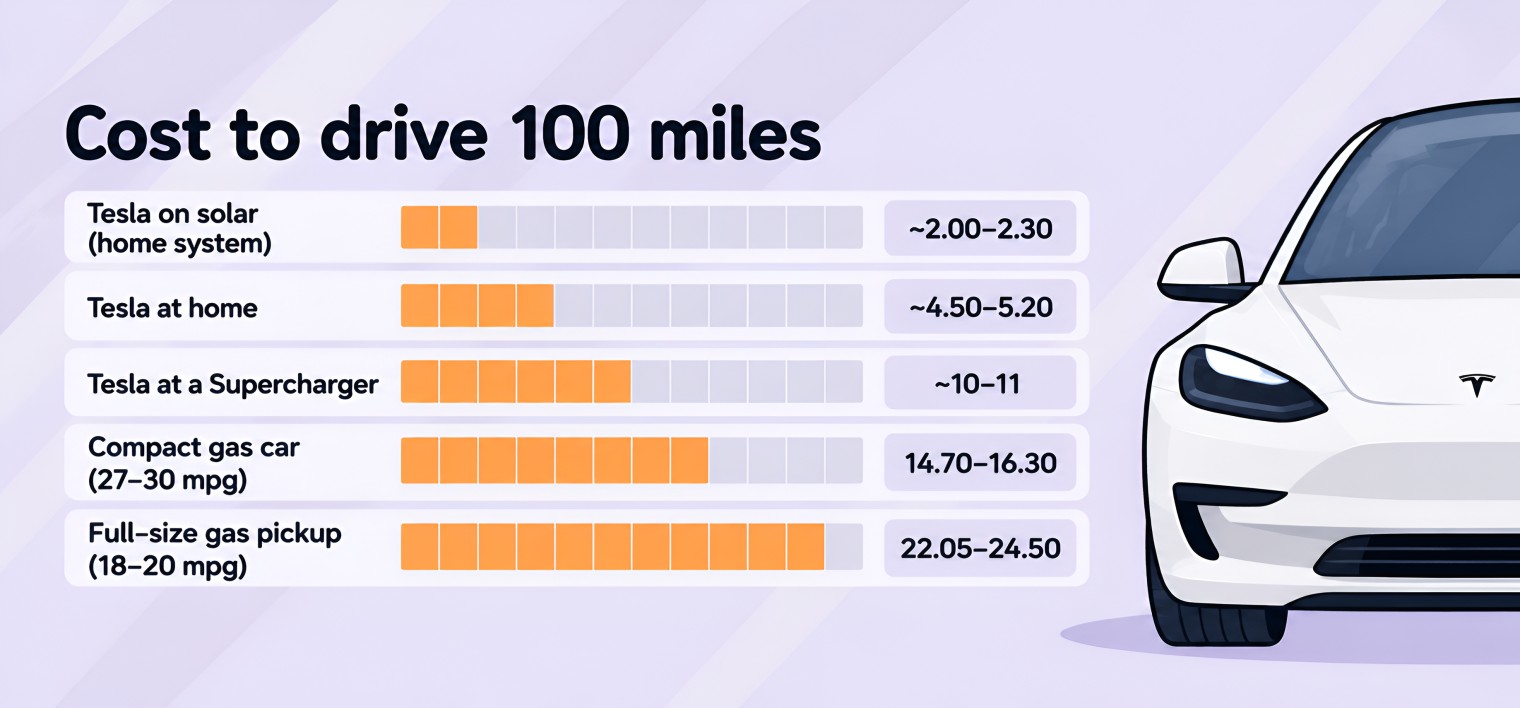
Model Y Premium for the Tesla rows, $0.18/kWh at home, $0.08/kWh solar, $0.43/kWh at Supercharger peak rates, and $4.41 a gallon for gasoline.
Your savings breakdown:
- Monthly: 100–170
- Annually:1,200–2,000
- Over 6 years: 7,200–12,200
These numbers don't even include EV maintenance advantages: no oil changes and fewer brake jobs thanks to regenerative braking.
1,200–2,000 a year
What a Tesla driver saves on fuel compared with a comparable gas vehicle at 1,000 miles a month and today's prices.
Charging Your Tesla With Solar Panels
Solar panels transform your charging economics. With solar, your effective charging cost drops to roughly $0.06–0.10 per kWh, about a third to a half of grid rates, even though the 30% federal tax credit no longer subsidizes the upfront cost.


Canadian Solar 355W Solar Panel 144 Cell BiKu Polycrystalline Bifacial CS3U-355PB-AG Clearance
- Rated Power Output 355 W
- Voltage (VOC)46.8 V
- Price per Watt0.3
- Number of cells144 Cell
- Cell TypePolycrystalline


Talesun Solar 415W Solar Panel 108 Cell PERC Bifacial All-Black TP7G54M(H)-415-BB Clearance
- Rated Power Output 415 W
- Voltage (VOC)37.75 V
- Price per Watt0.3
- Number of cells108 Cell
- Cell TypeMonocrystalline


Jinko 385W Solar Panel 132 Cells JKM385M-6RL3-B Clearance
- Rated Power Output 385 W
- Voltage (VOC)44.34 V
- Price per Watt0.35
- Number of cells132 Cell
- Cell TypeMonocrystalline
Real-world solar charging costs:
*Annual savings compared with grid charging at $0.18/kWh, using 13,500 miles a year, EPA energy use, and $0.08/kWh as a representative unsubsidized 2026 solar cost (the real range is $0.06–0.10/kWh depending on system size and local installed cost).
How many solar panels do you need?
For most Tesla owners, adding 6–8 additional solar panels covers annual charging needs. If you're planning a new solar installation, factor in your Tesla's energy requirements from the start.
Solar charging costs of $0.06–0.10 per kWh assume you've already installed a solar system and reflect the levelized cost of electricity from your panels. Installation costs for solar systems typically range from 15,000–30,000 with no federal credit applied. The 30% Residential Clean Energy Credit covered only systems whose installation was completed by December 31, 2025, so check state and utility incentives instead.
The investment typically pays for itself in roughly 8–15 years through charging and electricity savings, faster in states with expensive electricity and meaningfully slower where power is cheap. It then keeps cutting your fuel and electricity costs for the rest of the system's 25–30 year life, while achieving true zero-emission driving.
Solar charging works best with battery storage. Tesla Powerwalls or other home batteries let you store daytime solar production for overnight charging, maximizing your solar investment.
Many Tesla owners discover that their solar systems produce excess energy during sunny days. This surplus can charge their vehicle essentially for free, creating a closed-loop energy system for their home and transportation needs. Whether you run Tesla solar panels or a mixed-brand array, that daytime surplus is what turns near-zero charging costs into a year-round reality.
Example: An 8-panel addition (roughly 3.6 kW at 440–450W panels) generates enough electricity to drive your Model Y about 12,000–13,000 miles annually, covering most drivers' needs with sunshine.
Tips to Minimize Tesla Charging Costs
These strategies can cut your charging costs by 20–50%:
- Schedule smart Charge during off-peak hours (9 PM–6 AM) using Tesla's scheduler. Avoid peak demand periods (4–8 PM).
- Maximize efficiencyPrecondition your battery while plugged in during cold weather, follow your car's charge-limit guidance (Tesla recommends 80% for daily use on nickel-based packs and 100% on LFP packs), and use a Level 2 home charger, the most efficient option.
- Take advantage of utility programs・Special EV rate plans often offer 50% discounts during off-peak hours・Demand response programs pay you to reduce charging during grid stress
・Time-of-use plans can slash charging costs for flexible schedules - Go public, strategically・Plan routes around free charging at hotels, shopping centers, and workplaces・Use charging network apps to find the lowest prices in your area
・Check the live Supercharger price in the Tesla app before you plug in, and unplug at 80% on busy days to avoid congestion fees
Free charging opportunities:
- Workplace programs
- Hotel destination chargers
- Shopping center incentives
- Utility pilot programs
The Bottom Line
Tesla charging costs 44–77 a month for most drivers, a fraction of gasoline expenses, and the gap keeps widening as gas has climbed to $4.41 a gallon. A Model 3 Standard owner spending around $44 a month on electricity saves roughly 100–170 a month compared with fueling a comparable gas sedan or SUV. Over a typical 6-year ownership period, that adds up to 7,200–12,200 in fuel costs alone, before counting the maintenance electric vehicles rarely need.
Ready to maximize your savings? Check your utility's EV rate plans (some offer off-peak rates as low as $0.06/kWh), set up Tesla's scheduled charging, and consider solar if you own your home. With solar, a full charge can cost as little as 6–11, even without the federal tax credit. Between lower fuel costs, minimal maintenance, and home charging convenience, Tesla ownership stays compelling as gas prices stay volatile.
FAQ

Egor is passionate about making solar energy accessible and understandable for everyone. Since joining the company, he has been focused on sharing insights, practical tips, and ideas that help people embrace sustainable energy solutions.
More articles from this authorIllustrator: Dasha Vasina


