Share on ChatGPT
 Share on Grok

Power outages are hitting harder. Energy bills keep climbing. It's no wonder Tesla's sleek home battery has caught your attention — but beyond the marketing hype, what does a Tesla Powerwall 3 actually cost once the installer drives away? Tesla's own site won't even give you a number until you enter your address. Real-world pricing involves installation complexities, regional variations, and a maze of incentives — here's what actually moves the needle in 2026.
Quick answer: A Tesla Powerwall 3 costs 12,000–16,500 installed in the US in 2026, before incentives. The battery itself is estimated at about $9,200, and installation, the Gateway and permits add 2,600–6,900. Published benchmarks cluster at 13,000–16,500, and complex jobs can top $18,000. Across our 12,000–16,500 range, that works out to 889–1,222 per kWh of the 13.5 kWh capacity.
Key takeaways
- A Tesla Powerwall 3 costs approximately 12,000–16,500 installed before incentives — the exact number depends heavily on your region and whether your electrical panel needs an upgrade.
- Tesla's Next Million Powerwall rebate ($500 per Powerwall 3 or expansion unit, up to $1,000 per account and address) closed to new orders on June 30, 2026. If you already ordered, you have until December 31, 2026 to install, connect, and register (confirm with Tesla).
- The Powerwall 3 delivers up to 11.5 kW of continuous power and carries a 10-year warranty with a 70% capacity retention guarantee.
- Tesla's Powerwall 3P, a three-phase unit, became available in Europe in April 2026, with Germany first. The coverage we reviewed gives no US price or release date.
- In Texas, Tesla now leases two Powerwalls for 35 a month in the first year (122 minus an $87 Tesla Electric credit, with a 3% annual escalator), for homes without solar.
Breaking Down the Real Tesla Powerwall 3 Price: Installed vs. Hardware-Only (2026)
Let's cut through the confusion with real numbers. Tesla doesn't publish a Powerwall 3 price without your address, so there is no official figure to quote. What we can lay out is two numbers that answer different questions: what the battery alone costs, and what a complete, permitted installation costs.
What the 3,900–7,500 gap pays for (turning a battery into a working, permitted system):
- Installation, Gateway and permits: 2,600–6,900.
- Mounting hardware: 200–400.
Ask for an itemized quote, because cabling, conduit and breakers are sometimes folded into this line.
Before you buy:- Use a certified installer. Tesla's US warranty covers Powerwalls bought from Tesla or a Tesla-certified installer and excludes repairs or modifications by anyone else (Tesla warranty, US).
- Expect regional differences. Labor rates, permit fees and utility requirements vary, so a firm number comes only from a quote for your address.
Powerwall 3 Price Without Installation
Tesla's Powerwall 3 delivers up to 11.5 kW of continuous power — enough to run your refrigerator, lights, Wi-Fi, and even some air conditioning simultaneously during an outage. That 11.5 kW figure is the top tier of Tesla's own spec sheet, though — actual continuous output is wired at one of four levels depending on your home's electrical configuration, so confirm which tier your installer is quoting. Per Tesla's power-limit documentation:
These limits apply except where local grid code restricts them. Tesla notes that some utilities, including Con Edison, PECO, Georgia Power and NV Energy, may evaluate a unit at full 11.5 kW even if you set a lower limit, and says its list is not exhaustive.
Tesla Powerwall 3 Specs at a Glance
Powerwall 3 is also the battery that unlocks Tesla's vehicle-to-home feature. New Model 3 and Model Y vehicles can power a home through Powershare, but only with a Powerwall 3. The feature is guaranteed for cars ordered on October 1, 2026 or later (some older cars have it too, but not all), it is limited to the US and Puerto Rico, and Powerwall 2 and Powerwall+ support is listed as "coming soon." The Cybertruck works with Powerwall 3 as well.
Do your solar panels need maintenance?
Fill out form and compare offers from solar professionals
Get quotesHidden Costs That Can Blow Your Budget
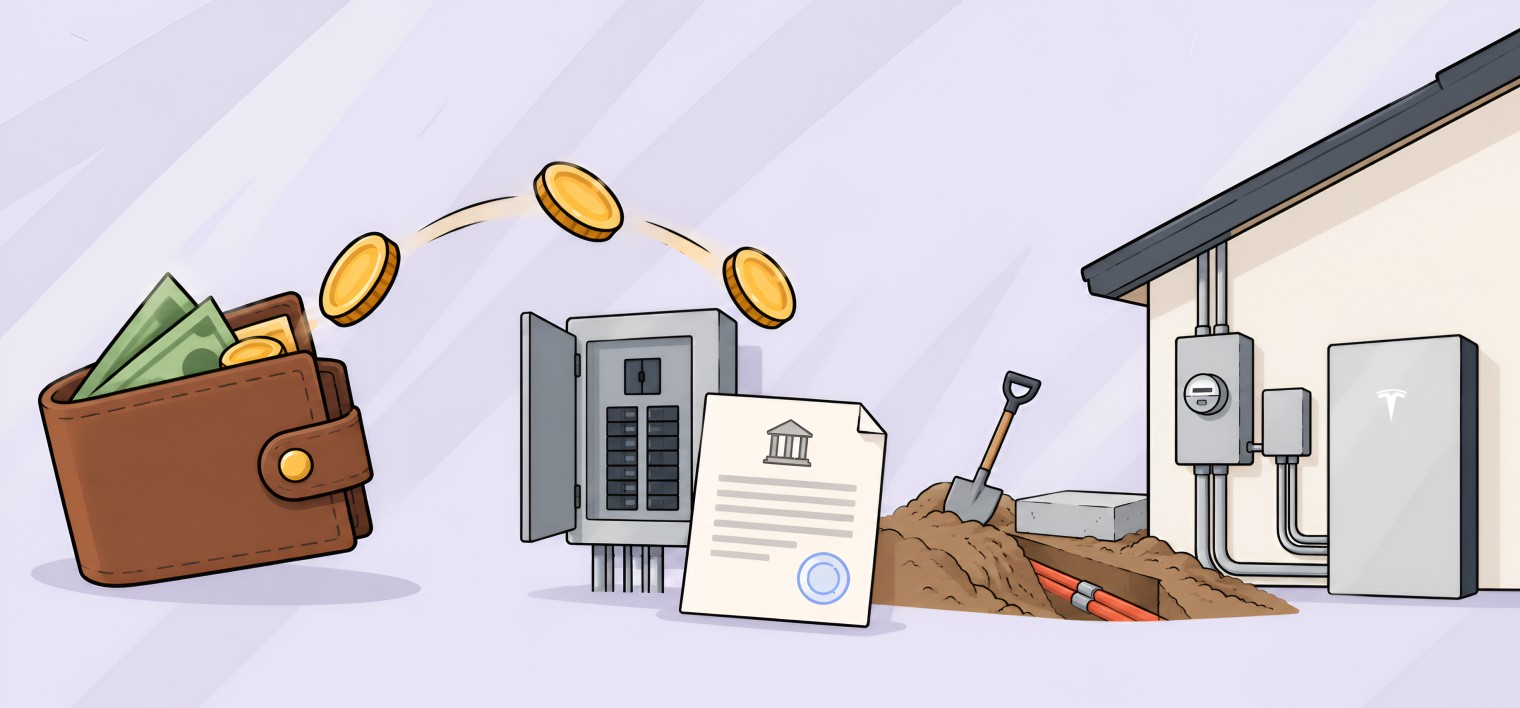
The advertised price rarely tells the complete story. Several additional expenses can push your final investment significantly higher than a first quote. The ranges below are our editorial estimates.
- Electrical panel upgrades — the most common surprise cost. Older homes with 100-amp or 150-amp panels often need upgrades to safely accommodate a Powerwall system. Typically 1,500–3,500, depending on your home's current setup and local codes.
- Permit fees vary wildly by jurisdiction — anywhere from a simple 100–200 flat fee to a complex review process costing 500–1,000 or more. Your installer should handle permits, but the cost gets passed through to your final bill.
- Ground prep & trenching for exterior installations — concrete pads, underground conduit, or landscape work can add 500–2,000.
- Whole-home backup design. Load management, longer wire runs, AC-coupled solar integration, service-equipment changes (such as a 400-amp service) and a backup switch can all raise the bill well beyond the standard range above. Ask for each item as a separate line in your quote.
Many homeowners choose to start with a modular "essential-load" kit, as an alternative. This allows you to protect your most critical appliances — like the refrigerator, lights, and Wi-Fi — at a fraction of the cost of a whole-home system.

5kWh Solar Backup: MidNite Power 48V LiFePO4 Battery + 5kW SRNE Hybrid Inverter - ESS kit
- AMP Hours100 Ah
- Voltage48 V
- ChemistryLiFePO4
Delivery on Nov 16–19
Tesla Powerwall 3 Installation Cost & Timeline: What to Expect
The unit price is only part of the picture — installation is a process, not a one-day transaction. Labor is a real line item, and it varies by installer and region. Here's the rough shape of the process:
Most homeowners go from signed contract to a working system in roughly 6–14 weeks. Utility interconnection queues in some counties can push that even further — ask your installer for a realistic estimate specific to your utility territory before you sign anything.
Expansion Units: The Smart Way to Scale
Tesla's expansion units offer the most cost-effective way to increase your storage capacity. They are DC-coupled and have no inverter of their own: the main Powerwall 3 handles power conversion, site control and solar coupling. Tesla hasn't published an official retail price. SolarReviews uses $5,900 per unit, before labor. At $5,900 you're adding 13.5 kWh of storage for about $437 per kWh, hardware only. A second complete Powerwall 3 costs more: online listings show the battery alone at 8,110–9,034 (about 600–670 per kWh), before the labor to install it.
A single Powerwall 3 can support up to three expansion units, creating a 54 kWh system. That is roughly 1.8 days at the average US home's usage of about 30 kWh a day, and longer if you back up only essential loads. Here's how the economics break down for a representative single-unit install priced at $15,600 (within the 12,000–16,500 range above):
 How Long Do Tesla Batteries Last? The Complete Guide to EV Battery Life
The table adds about $5,900 per expansion unit, so treat the larger totals as estimates and expect each added unit to land at or slightly above that figure once labor is included.
Tesla Powerwall Warranty: What's Covered
A big number on the price tag means little without knowing how long it lasts. Tesla backs the Powerwall 3 with a 10-year warranty that guarantees at least 70% of its original 13.5 kWh capacity at year 10. For solar self-consumption, time-based control and backup, cycles are unlimited. For any other use, the warranty is capped at 37.8 MWh of aggregate throughput.
One condition worth knowing: Tesla says that if your Powerwall isn't connected to the internet for an extended period, or was never registered with Tesla, it may not be able to honor the full ten-year warranty. In that case it will always honor the warranty for at least four years from first installation. So don't skip the app setup or let your home Wi-Fi lapse for long stretches.
Confirm the exact terms for your specific unit and installation date on Tesla's own warranty page before you sign anything — terms are occasionally updated, and it's a five-minute check against a decade-long commitment.
Incentives and Rebates: What's Available in 2026
The 30% federal residential tax credit (Section 25D) is gone. It expired on December 31, 2025 under the One Big Beautiful Bill Act (signed July 4, 2025), so systems installed after that date don't qualify. What's left is one Tesla-specific rebate, a handful of state and utility programs, and lease options. None of it matches what the federal credit used to cover, but it's real money when stacked together.
Tesla's Next Million Powerwall rebate pays $500 per Powerwall 3 or Powerwall 3 Expansion, up to $1,000 total, for up to two units per Tesla account and installation address.
New orders are closed: the order window ran from November 1, 2025 through June 30, 2026, and registration in Tesla's rebate portal was also due by June 30. If you ordered inside that window, you have until December 31, 2026 to install, connect, and register the system, and the final rebate request is due the same day. Installations after December 31, 2026 won't qualify, and Tesla's page says leased and PPA installations can qualify too.
Section 48E and leases. The business credit still exists, and it can apply to leased or PPA systems and covers standalone storage.
State and local programs
California
Budgets and rates change often, so check each official page before you plan around a rebate. The figures below are for a 13.5 kWh battery.
- SMUD. SMUD's page says its upfront incentive fell from $500 per kWh to $300 per kWh (up to $6,000) for interconnection applications received on or after September 23, which is 3,240 for a Powerwall 3. Projects submitted by September 22 and enrolled by December 31, 2026 keep the old rate (5,400). Confirm the dates with SMUD.
- Riverside Public Utilities. RPU pays $500 per kWh (up to $10,000), or $6,750, for batteries bought on or after July 1, 2026, and $850 per kWh (up to $17,000), or $11,475, for SHARE-enrolled low-income customers. It requires a domestic time-of-use rate and is subject to fund availability.
- Pasadena Water and Power. PWP pays 350 per kWh (4,725), plus 200 per kWh more for customers enrolled in its assistance programs (7,425 in total). It requires at least 36 months in PWP's demand response or virtual power plant program, and funds are limited.
- Other states. SolarReviews names California, North Carolina, New York and Colorado as the states with the strongest battery rebates. Terms and budgets change often, so ask your installer for the current program in your utility territory.

- AMP Hours314 Ah
- Voltage48 V
- ChemistryLithium, LiFePO4
Delivery on Nov 10–16
Powerwall 3 and the New 3P: Which One Do You Need?

Tesla now has two Powerwall 3 variants — the standard Powerwall 3 and the newly launched three-phase Powerwall 3P — but Tesla's US Powerwall page lists only the standard one. For most American homeowners, the choice is straightforward: the standard Powerwall 3. But understanding both helps you size your system correctly, and avoid waiting on a product that isn't headed to your driveway anytime soon.
US installers shouldn't be assumed to have it. If you run a small workshop, restaurant, medical office, or any commercial space with three-phase service, it's a product worth keeping an eye on — just not one to hold off your purchase for.
The Powerwall 3 is the baseline unit — 13.5 kWh of storage, 11.5 kW of continuous power, built-in solar inverter, floor- or wall-mounted, compatible with up to three Expansion Packs. Installed pricing runs 12,000–16,500, depending on location.
The Powerwall 3P was first announced for Germany in February 2026. It integrates a battery, hybrid inverter, and home energy management system into a single unit, with a storage capacity of 13.4 kWh and up to 15.4 kW of AC power. Up to four systems can be combined for 94.5 kWh and 61.6 kW, and installation is limited to certified partners. The "P" stands for three-phase — it's built for grids that run on three-phase power.
Vasilii SmirnovSolar Installation ExpertWhat I tell customers is simple: it keeps your essentials running when the grid goes down, and paired with solar, it can meaningfully cut your bill. Everything's controlled from the Tesla app, the inverter's already built in — so we can mount it inside or outside without extra gear — and you can scale up to four units if one isn't enough.

Tesla vs Competitors: How Does It Stack Up?
Put the Powerwall 3 next to its rivals and the price gap shows up in real quotes. At $889–$1,222 per kWh installed — based on the $12,000–$16,500 range above for 13.5 kWh of storage — the Powerwall 3 is competitive.
Prices in the table are not like-for-like: the Powerwall 3 and aPower 2 figures are installed averages, while the Generac and Anker figures are equipment estimates before installation, and Enphase publishes none.
Warranties aren't directly comparable. Tesla guarantees 70% capacity at year 10; Enphase and Anker disclose a 60% floor (at 15 and 10 years); EnergySage lists 70% for FranklinWH. FranklinWH (60 MWh) and Generac (7.56 MWh) also cap coverage by throughput, not just years. FranklinWH also markets a solar-retrofit solution for adding storage to existing solar, so ask about compatibility with your inverter. Tesla's combination of price, nationwide certified-installer network, and brand recognition is a big part of why it remains the default recommendation for most homeowners.
Furthermore, high-demand homes with multiple heavy appliances may want a system with more power headroom. For those who prioritize raw performance and hardware flexibility, a professional-grade Energy Storage System (ESS) kit can be a practical alternative: the 16 kWh kit above pairs 16 kWh of storage with an 18 kW hybrid inverter, at an equipment price in the same range as the Powerwall 3's core hardware. Installation is extra either way, so compare per-kWh equipment prices and get an installation quote before you decide.

14kWh Whole Home Backup: Rubix 48V LiFePO4 Battery + 15kW Sol-Ark Hybrid Inverter - ESS kit
- AMP Hours280 Ah
- Voltage48 V
- ChemistryLiFePO4
Delivery on Nov 16–19
ROI Reality Check: When Does It Make Financial Sense?
The financial case for a Tesla Powerwall depends heavily on your local utility rates and outage frequency. Pairing the battery with Tesla solar panels strengthens that case considerably — storing your own daytime generation for evening use is where the system earns back its cost fastest.
These payback ranges are our editorial estimates, not figures from a published study. The backup power value is harder to quantify but often drives purchase decisions. What's it worth to keep your home office running during a power outage? How about preserving hundreds of dollars of refrigerated food during an extended blackout? These benefits don't appear on a utility bill, but they provide real value to many homeowners.
Tesla Powerwall Cost Per Month: Leasing Options
Texas: two Powerwalls for $35/month in year 1, no installation cost
Smart Shopping Strategies
Shopping around pays off, even with Tesla's standardized pricing. Different certified installers may offer varying labor rates, financing options, or package deals that affect your total cost.
Obtain quotes from at least three Tesla-certified installers in your area. Compare not just pricing but also installation timelines, warranty coverage, and post-installation support — some installers include system monitoring or maintenance packages that add value beyond the base install.
Timing your purchase strategically can yield savings, too. Installers often offer better pricing during slower winter months when solar installation demand drops, and end-of-quarter periods may present opportunities as installers work to meet sales targets.
Is the Tesla Powerwall 3 Worth It? Quick Verdict
Consider it if:
- Your area sees frequent or extended power outages
- You're on a time-of-use rate and can shift usage to off-peak hours
- You already have, or are installing, solar panels
- You drive a Cybertruck, or plan to order a new Model 3 or Model Y (ordered October 1, 2026 or later), and want vehicle-to-home backup through Powershare
Look at alternatives if:
- Your grid is stable and your flat electricity rate is already low
- Budget is the deciding factor — compare per-kWh equipment prices, since an ESS kit can offer more capacity and a larger inverter at a similar equipment price
- You need three-phase commercial power today (no US price or release date has been announced for the Powerwall 3P)
While bundling a Powerwall with solar maximizes your system's efficiency, budget for the installation costs and rebate timing detailed above — both can move your final number more than the sticker price does. If the total investment feels out of reach, check Tesla's lease options where available, and compare an ESS kit on a per-kWh basis for similar grid independence.
Frequently Asked Questions

Sergey has been running A1 SolarStore since 2017 with the main idea in mind – making going solar easier for everyone. Based on a thorough market research and his personal experience, he shares his ideas on both solar industry and management related topics
More articles from this author