


 Share on ChatGPT
 Share on Grok

A Tesla battery doesn't fail on a particular Tuesday. It fades, slowly, and enough cars have now been measured to say how slowly. Tesla's fleet data, 500,000 independent battery tests and a Model S with three million kilometers on the clock tell one story: the pack usually outlives the owner.
Quick answer:
Tesla batteries are engineered to last 300,000–500,000 miles — about 15 to 20+ years for the average driver — before dropping below Tesla's 70% capacity threshold.
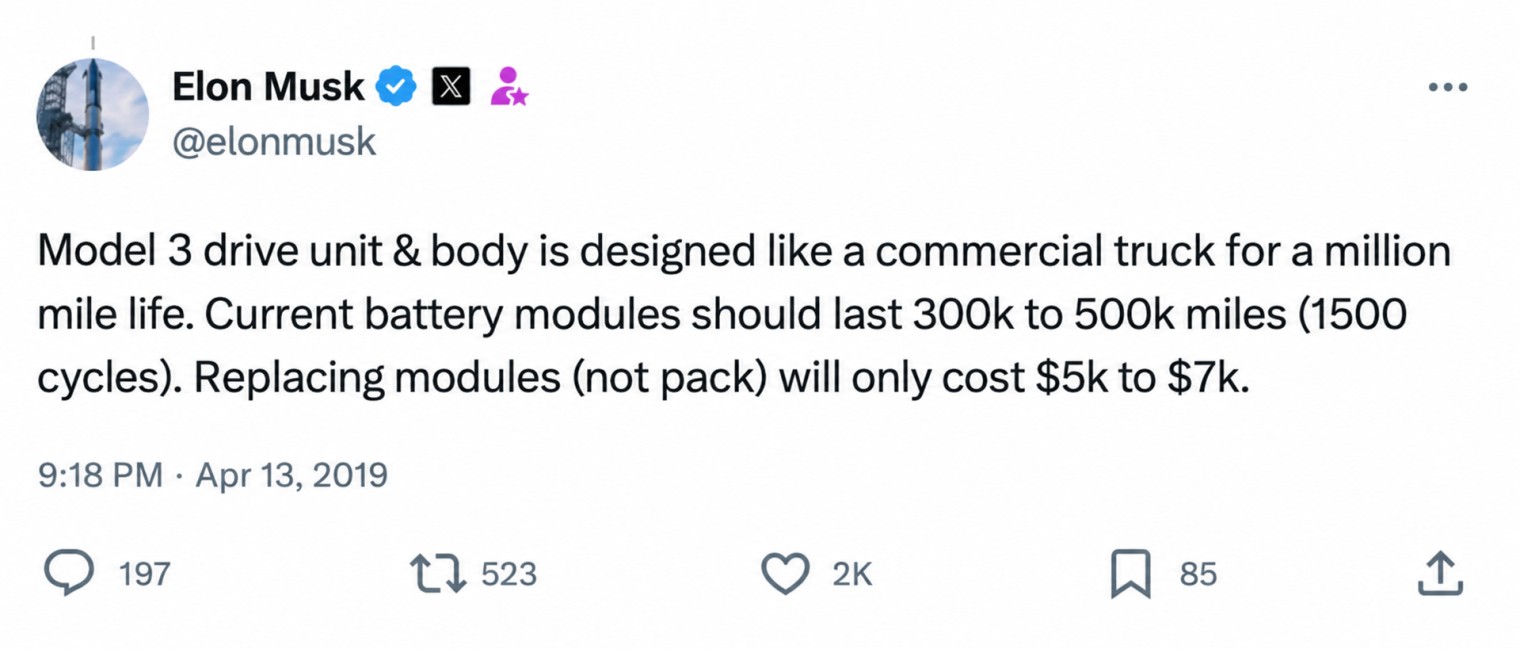
That range comes from a 2019 post by Elon Musk about the Model 3's battery modules, where he also cited a 1,500-cycle design life. Read it as a design target, not a guarantee. The measured picture is narrower and still comfortable: about 85–88% of capacity left at 200,000 miles, and a warranty that guarantees 70%.
Key takeaways
- Tesla batteries lose around 12–15% of their capacity over 200,000 miles. Tesla reports an average loss of 15% for the Model 3 and Model Y Long Range and 12% for the Model S and Model X.
- Battery degradation is also visible in independent tests. In AVILOO's 2026 study, the Model Y retained 90.3% of its original battery capacity after 150,000 km (93,205 miles), while the Model 3 retained 88.9%.
- Tesla's battery warranty covers 8 years or 100,000–150,000 miles. The exact mileage limit depends on the model and trim. During this period, the battery is covered against capacity loss below 70%, subject to the warranty terms.
- Battery replacements are rare in electric cars. According to Recurrent, just 0.3% of EVs from model year 2022 onward have had their batteries replaced, excluding recall-related replacements.
- Your daily charging limit depends on the battery type. For most Tesla models with nickel-based batteries, Tesla recommends a daily limit of 80–90%. Models with LFP batteries can generally be charged to 100% regularly, as recommended by Tesla.
What Determines Tesla Battery Life?
Tesla battery longevity, meaning the lifespan of Tesla battery packs, is a question of how fast capacity fades, not whether the pack suddenly stops. Capacity slips gradually, the way a phone battery holds a little less each year. Two mechanisms do the work. Calendar aging runs on the clock: slow chemistry inside the cells that continues whether the car drives or sits. Cycle aging runs on charging cycles: each swing from high to low charge costs a little, and deeper swings cost more.
State of health (SoH). The share of original usable capacity a battery still holds. A car rated at 300 miles with 90% SoH has a pack that can deliver roughly 270 miles under the same conditions.
Charging power and climate tilt both mechanisms. The best large dataset on this comes from Geotab's 2025 analysis of 22,700+ EVs across 21 models:
These numbers describe EVs in general, not Teslas specifically. Treat them as direction, not as a Tesla verdict.
3.0% vs. 1.5%
Average yearly capacity loss for EVs that fast-charge often and mostly above 100 kW, compared with EVs that rarely fast-charge (under 12% of sessions).
Charging habits round out the picture. Regularly topping up to 100% or running the pack down to near-zero adds stress Tesla's battery management system can only partly offset — mindful charging still buys extra years.
How Long Will a Tesla Battery Last in Years and Miles?
The average U.S. vehicle lasts about 200,000 miles, and Tesla owners drive more than most: 13,768 miles a year in a Model Y, against 11,142 for the average vehicle. At that pace, 200,000 miles takes 14.5 years. So how many years do Tesla batteries last? The mileage math gives roughly 15 to 20+ years for a typical driver.
13,768 miles
Average annual mileage for Tesla Model Y vehicles in the U.S., versus 11,142 miles for the average U.S. vehicle.
Mileage is only part of the picture. A battery also loses capacity as it ages, even if the car isn't driven much. At an average degradation rate of 2.3% per year, it would take about 13 years to reach 70% of its original capacity. But battery aging doesn't follow a straight line: capacity often drops faster in the early years, then declines more slowly. Based on these patterns, we'd put a Tesla battery's lifespan at roughly 13–20 years, depending on the car's age, mileage, and usage.
Geotab's 2025 analysis of more than 22,700 EVs across 21 models found an average annual battery capacity loss of 2.3%, up from 1.8% in its earlier analysis.
How many miles does a Tesla last: the battery or the whole car?
Battery and car run on different clocks. One German owner's 2013 Model S P85+ reached 3,000,000 km (1,864,113 miles) in September 2026, according to the owner. It is on its fourth battery pack and had gone through 14 motors by 1.8 million km, mostly remanufactured units that failed from coolant-seal leaks. The latest pack, installed in 2023, has covered 1,000,000 km with 85% capacity remaining.

That car is an outlier, but it shows how Tesla life expectancy splits in two: in this car the motors were replaced more often than the battery (14 motors against four packs). For the life of Tesla vehicles in general, the benchmark is the 200,000-mile figure above, which is why "how many miles do Teslas last" has a battery answer and a car answer that are not identical.
Real-World Tesla Battery Performance Data
Tesla's own fleet data is the largest public dataset. In its 2023 Impact Report, Tesla says Model 3 and Model Y batteries lose 15% of capacity on average after 200,000 miles, and Model S and Model X batteries lose 12%.
15% and 12%
Average capacity lost after 200,000 miles: 15% for Model 3 and Model Y Long Range, 12% for Model S and Model X.
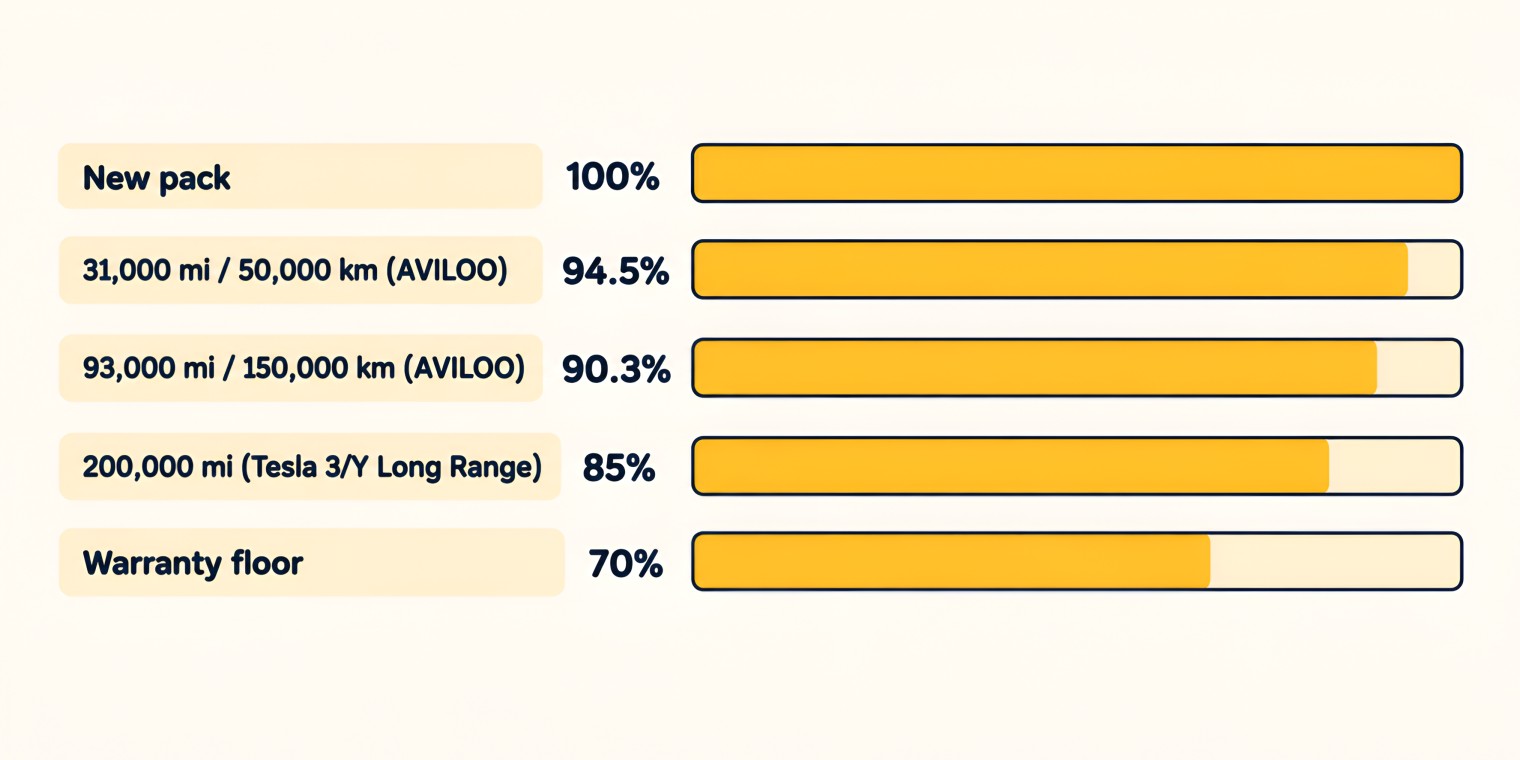
Independent measurements are less flattering and more useful. AVILOO, an Austrian battery-diagnostics company, published a study in September 2026 built on more than 500,000 independent tests of used cars across 20 models, collected from 2022 to 2026. The median Model Y fell from 94.5% battery health at 50,000 km to 90.3% at 150,000 km. The Model 3 reached 88.9%.
Most models clustered between 90% and 94%, so the Model Y sits at the low end of that band and the Model 3 just below it. AVILOO calculates health with its own statistical model from OBD data, not from the car's display, and its figures combine several pack sizes per model.
A quick picture of the curve for a Model Y, using the figures above (each block ≈ 5% of capacity):
How Long Do Tesla Model 3 and Model Y Last?
Both cars share the same warranty tiers and similar packs, and Tesla reports their fleet data together.
The spread matters more than the median. AVILOO's 99% range for the Model 3 at 150,000 km runs from 80.3% to 94.5%, so the model name predicts less than the individual car's history. For Tesla Model 3 battery life and Tesla Model Y battery life alike, the honest answer is "about 10–11% down at 93,000 miles, with a wide band around it."
Two high-mileage examples show the upper end. A Model X 90D run hard in a shuttle fleet covered 350,000 miles with about 13% estimated range fade, based on the operator's own records from 2018. The 3-million-kilometer Model S above sits in a different league. Neither is typical, and both are proof that the chemistry doesn't hit a wall at 200,000 miles.
How Many Miles Does a Tesla Battery Last per Charge?
Range and lifespan get mixed up constantly. Range is how far one charge takes you today. Lifespan is how that number shrinks. A pack's range tracks its health, so you can estimate an aged car's range by multiplying its original EPA rating by its state of health. The EPA rating for each trim is listed on fueleconomy.gov.
This is straight arithmetic. Real range also moves with speed, temperature and tires. The same math answers "how many hours does a Tesla battery last": at a steady 65 mph, a 250-, 300- or 350-mile range lasts roughly 3.8, 4.6 or 5.4 hours behind the wheel.
 Tesla MPG: Why Your Model Might Not Be as Efficient as You Think
Tesla's Official Battery Warranty and Expectations
The Tesla battery warranty, which the company pitches as industry-leading warranties, covers the battery and drive unit for 8 years or a mileage cap, whichever comes first, with a guaranteed minimum of 70% capacity retention. The Tesla battery mileage cap depends on the trim:
Solar systems may appear complicated. First, you have to choose all these different elements and make sure they match. Then, the installation starts and it also can be stressful and time-фModel S and Model X production ended in Q2 2026, but existing owners keep their original coverage. The warranty also transfers with the car when ownership is transferred through Tesla.
consuming. Here is the good news: a system made of AC solar panels is much simpler. Well, is there any bad news? What are these ACpanels anyway? Let's find out.
Count both limits. At the Model Y average of 13,768 miles a year, a 100,000-mile cap runs out at about 7.3 years and a 120,000-mile cap at about 8.7 years. On 120,000-mile trims the 8-year limit usually arrives first.
That 70% floor is real range, not just a spec line. A car rated at 300 miles that dropped to 70% inside the warranty would still deliver about 210 miles, and would qualify for repair or replacement.
Extended coverage: Tesla's Battery ESA
Tesla now sells an extension for the two most expensive parts of a car: the Tesla HV battery and the drive unit. The High Voltage Battery and Drive Unit Extended Service Agreement, or Battery ESA, works like this:
- Eligible cars: Model 3 and Model Y bought new or Certified Pre-Owned directly from Tesla and not leased.
- Coverage: up to 24 months or 30,000 miles beyond the original warranty, whichever comes first.
- Deductible: $500 per service visit with a covered repair.
- Price: $2,000 in the U.S. per Tesla's terms, a one-time purchase in the Tesla app.
- Deadline: buy it before the original warranty expires. There is no grace period.
- Transfer: an active ESA passes to the next owner, but you can't buy one on a car you purchased elsewhere.
- Not covered: gradual capacity loss. Tesla's terms exclude degradation and loss of battery energy over time, so the ESA protects against failures, not fade.
$500
Deductible per service visit under Tesla's Battery ESA. Parts outside the high-voltage battery and drive unit are not covered.
How to Check Your Tesla's Battery Health
The Tesla battery health figure on screen is an estimate from the car's own software, and such displays don't always match the real battery state. For a real reading, pick the method that fits your car:
In our view, a full discharge test isn't worth repeating monthly: it is one deep cycle, and the result moves slowly. Check once a year, or before you buy or sell.
Maximizing Your Tesla Battery Lifespan

Charging habits matter more than anything else you control. The rules differ by chemistry, which is where most generic advice goes wrong.
Battery Chemistry Comparison
Tesla's owner's manual tells LFP owners to keep the charge limit at 100% for daily use and to fully charge at least once a week. That also keeps the battery management system's capacity estimate accurate. Tesla had stopped selling LFP-equipped cars in the U.S., so most American owners follow the 80–90% rule. The charge slider on your own car is the reliable check. The same chemistry has spread into home backup, where LiFePO4 batteries have become common because they tolerate daily full cycles.
The Cybertruck uses Tesla's larger 4680 cells, and Tesla said in its Q4 2025 report that it had begun building packs for certain Model Ys with them too.
Temperature and driving
Heat is the factor worth guarding against. The effect may seem small from year to year, but it can add up over the life of your Tesla.
- Park in a garage or shade when you can.
- Use Cabin Overheat Protection in summer.
- Precondition the pack while plugged in before driving in extreme weather.
- Plug in even when you don't need the charge, so the thermal system can hold a good temperature.
- Skip DC fast charging when the pack is very hot or very cold.
Driving style counts less than charging, though smooth acceleration and regenerative braking keep the pack inside its comfortable range.
Charging from your own roof
Home solar nudges habits in the right direction: slow daytime top-ups instead of high-power fast-charging stops. Pairing an EV with Tesla solar panels is one route; a home array built from solar kits is another. At the 3.8 EPA miles per kWh Tesla cited for the Model Y AWD in its 2023 report, 13,768 miles a year needs about 3,600 kWh, or roughly 10 kWh a day, before charging losses.
 How long do solar panels last? Quite a while
Tesla Battery Replacement: Costs and Process
Most owners never replace a pack. Recurrent, which tracks EV battery health through telematics, found that fewer than 4% of the EVs in its community of 30,000+ cars have had a battery replaced, excluding major recalls. Recurrent notes that its community isn't representative of every EV on the road. The rate falls sharply with newer cars:
So when do Tesla batteries need to be replaced? There are three causes, all rare: a manufacturing defect, age-related deterioration, and damage.
If you're past the warranty, expect a bill. Tesla battery replacement cost isn't published, so the ranges below are rough market estimates, not Tesla price lists. Check the current price with Tesla Service before you decide.
A replacement pack bought from Tesla carries its own coverage: Tesla's parts warranty lists the high-voltage battery at 4 years or 50,000 miles. Warranty work has to go through a Tesla Service Center. Outside warranty, Tesla says you can use any shop, and that it isn't responsible for problems caused by improper third-party repair. In other words, a cheaper quote can be worth it, but it moves the risk to you.
Before paying for a replacement, confirm three things: whether the original warranty still runs, whether the Battery ESA is active, and whether the car's battery health actually sits below 70%. Many "battery problems" turn out to be software range estimates or a bad cell group.
Buying a Used Tesla: A Battery Checklist
A used Tesla is a bet on one specific pack, so check it like one.
- Check battery health. Ask for a measured battery health figure, not the range shown on the display.
- Check warranty coverage. Confirm how much of the 8-year warranty is left. It transfers with the car through Tesla.
- Identify battery chemistry. A charge slider with "Daily" and "Trip" settings indicates a nickel-based battery, while a percentage-only slider indicates LFP.
- Check for recalls. Run the VIN through Tesla's and NHTSA's recall lookups.
- Review charging habits. Ask how the car was charged. Mostly home AC is the best answer; habitual stops above 100 kW are the worst.
- Check Battery ESA status. You can't buy a new one on a car you purchased elsewhere, but an active one transfers.
How Long Do Tesla Home Batteries Last?
Tesla's Powerwall carries a 10-year limited warranty with 70% energy retention at 10 years, measured against a 13.5 kWh rating. Cycles are unlimited for solar self-consumption, time-based control and backup; other uses are capped at 37.8 MWh of throughput. That is the answer to "how long do Tesla home batteries last" on paper: a decade, provided the unit stays online. Without a connection, Tesla commits to at least four years.
Buyers who want Powerwall-class capacity outside Tesla's ecosystem have options. The Powerwall alternatives category shows what's available, and two examples below match different budgets.

Discover Energy Helios 52-48-16000 16.1 kWh 314Ah 48V Outdoor-Rated High-Performance LiFePO4 Battery
- AMP Hours314 Ah
- Voltage48 V
- ChemistryLithium, LiFePO4
Pickup on Wed, Nov 18 from Millersburg, OH
Delivery on Nov 13–18

SimpliPHI 6.6 Battery 6.65kWh LFP 48V Stackable (by Briggs & Stratton)
- AMP Hours130 Ah
- Voltage48 V
- ChemistryLithium, LiFePO4
Pickup on Wed, Nov 18 from Tucker, GA
Delivery on Nov 18–23
Whichever pack you pick, make sure it talks to your inverter. The Helios, for example, communicates over CAN, so confirm that your hybrid inverters support that protocol before you buy.
Frequently Asked Questions
The battery is the part of a Tesla you should worry about least. Treat the warranty as insurance against the rare dud, not as a countdown, because the data says the pack usually outlives your ownership.

Egor is passionate about making solar energy accessible and understandable for everyone. Since joining the company, he has been focused on sharing insights, practical tips, and ideas that help people embrace sustainable energy solutions.
More articles from this authorIllustrator: Dasha Vasina


