


 Local pickup only
- By: Sergey Fedorov
- Solar PV panels
- Updated: Nov 25, 2026
Solar Panel Price Trends: What Happens After Dec. 4? A1 Solar Index Q3 2026


Canadian Solar 355W Solar Panel 144 Cell BiKu Polycrystalline Bifacial CS3U-355PB-AG Clearance


Jinko 385W Solar Panel 132 Cells JKM385M-6RL3-B Clearance
Pickup on Thu, Dec 3


JA Solar 405W Solar Panel 108 Cells PERC All-Black JAM54S31-405/MR Clearance
Pickup on Wed, Dec 2


Trina 415W Solar Panel 144 Cell TOPCon Bifacial All-Black TSM-415NE09RC.05 Clearance
Pickup on Wed, Dec 2
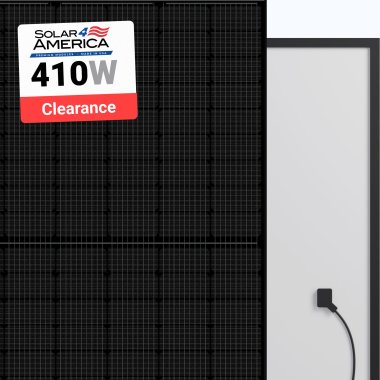
Solar4America 410W Solar Panel 108 Cell All-Black S4A410-108MH10 Assembled in USA Clearance


Q CELLS 410W Solar Panel 132 Cell Q.ANTUM Q.PEAK DUO BLK ML-G10+ Assembled in USA Clearance


Phono Solar 440W Solar Panel 108 Cell PERC Bifacial PS440M8GFH-18/VNHB Clearance


JA Solar 440W Solar Panel 108 Cell N-Type Bifacial JAM54D41-440/MB Clearance
Pickup on Wed, Dec 2


LONGi 540W Solar Panel 144 Cell Bifacial LR5-72HBD-540M Clearance


Seraphim 440W Solar Panel 108 Cell TOPCon Bifacial All-Black SRP-440-BTD-BG Clearance
Pickup on Thu, Dec 3


Hyperion (Runergy) 440W Solar Panel 108 Cell N-Type Bifacial HY-DH108N8B-440 Clearance


Solarever 450W Solar Panel 96 Cells N-Type Bifacial All-Black SE-182*105-450M-96-BD Clearance


Hyundai 405W Solar Panel 132 Cell PERC Bifacial HiS-S405YH(BK) Clearance
Pickup on Wed, Dec 2
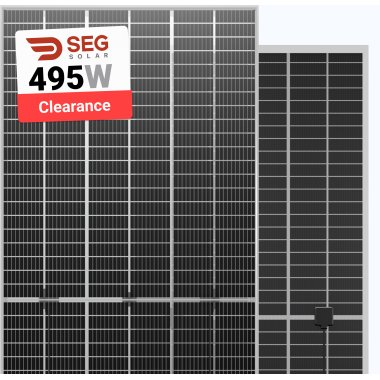
SEG Solar 495W Solar Panel 120 Cell N-Type Bifacial Dual Glass SEG-495-BTB-BG Clearance


Aptos Solar 415W Solar Panel 108 Cells BOB DNA-108-MF10-415W Clearance
Pickup on Thu, Dec 3


Meyer Burger 385W Solar Panel 120 Cell HJT All-Black MB_B120AyB_385 Clearance
Pickup on Tue, Dec 8


Philadelphia Solar 450W Solar Panels 108 Cell N-Type Bifacial All-Black MNB108(HCBF)-450W Clearance


Aptos Solar 460W Solar Panel 120 Cell PERC Bifacial DNA-120-BF10-460W Clearance
Pickup on Wed, Dec 2


Trina 445W Solar Panel 96 Cell N-Type TOPCon Dual Glass Full Black TSM-445-NEG9RH.25 Clearance
Pickup on Wed, Dec 2


Hyundai 440W Solar Panel 108 Cell N-Type TOPCon Bifacial All-Black HiS-T440NF(BK) Clearance
Pickup on Tue, Dec 8
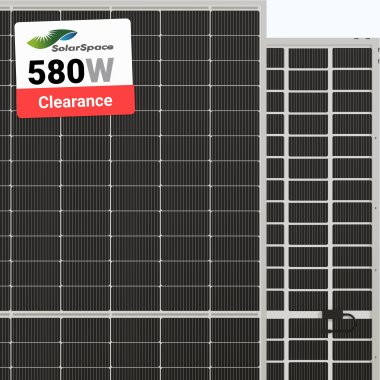
SolarSpace 580W Solar Panel 144 Cell TOPCon Bifacial SS8-72HD-580N

The discount solar panel market offers a legitimate pathway to energy independence for budget-conscious buyers—provided you know how to distinguish genuine value from compromised quality. This guide reveals how to evaluate discounted panels, verify warranties, and calculate true lifetime value.
Discount solar panels are photovoltaic modules sold at 20-50% below standard retail pricing through manufacturer overstock, previous-generation inventory, or seasonal promotions. A 400-watt monocrystalline panel retailing at $280 might appear at $165 through distributor clearance events same specifications, different availability status.
The critical distinction: previous-generation 380-watt panels with 19.8% efficiency often outperform current budget models despite clearance pricing, whereas deeply discounted no-name brands with vague specifications typically reflect compromised manufacturing.
Request the panel's datasheet showing nameplate specifications before purchasing. Legitimate discounts maintain full technical documentation including efficiency ratings, temperature coefficients, and warranty terms.
Previous-generation tier-1 monocrystalline panels offer the strongest value proposition—launched 18-24 months prior, featuring 19-21% efficiency with manufacturer warranties from established companies. The performance gap between a 2024 model at $0.45 per watt and a 2026 model at $0.70 per watt rarely justifies the 55% price premium.
Polycrystalline panels work well for installations with ample roof space where slightly lower efficiency (15-17%) doesn't constrain system sizing.
| Panel Type | Efficiency | Best For | Price/Watt |
|---|---|---|---|
| Previous-Gen Monocrystalline | 19-21% | Limited roof space | $0.45-$0.55 |
| Polycrystalline | 15-17% | Ample roof area | $0.35-$0.42 |
| Current Budget Mono | 17-19% | Balanced approach | $0.48-$0.58 |
Tier-1 manufacturers maintain 10-12 year product warranties plus linear performance warranties guaranteeing 80-85% output after 25 years, regardless of clearance pricing. Budget panels from lesser-known manufacturers often advertise comparable periods but lack institutional backing to honor long-term claims.
Read the actual warranty certificate, not marketing summaries. Comprehensive warranties specify exact performance degradation curves, clear claim processes, and transferability provisions.
Manufacturing overruns from quarterly production batches, model transitions when manufacturers launch updated panel lines, cosmetic imperfections (slight discoloration, frame scratches) that don't impact performance.
Absence of manufacturer identification, pricing below $0.30 per watt for current-generation specs, missing technical datasheets, third-party warranty registration requirements, sellers unable to provide contractor references.
Analyze lifetime energy production, not just upfront cost. A $150 panel producing 8,500 kWh over 25 years delivers energy at $0.0176 per kWh, whereas a $250 panel generating 10,200 kWh achieves $0.0245 per kWh—making the expensive panel cost 39% more per unit of electricity.
Calculate by dividing panel price by wattage rating: a $180 panel at 400 watts equals $0.45 per watt. However, adjust for efficiency by normalizing to a 20% baseline, enabling direct comparison across different efficiency classes.
| Panel Type | Price | Wattage | Efficiency | Cost/Watt | 25-Year Production | Lifetime Cost/kWh |
|---|---|---|---|---|---|---|
| Premium Current | $285 | 420W | 21.2% | $0.68 | 10,920 kWh | $0.0261 |
| Previous-Gen | $195 | 400W | 20.1% | $0.49 | 10,200 kWh | $0.0191 |
| Discount Poly | $145 | 360W | 16.8% | $0.40 | 8,640 kWh | $0.0168 |
Calculate total wattage needs, then determine if lower-cost, lower-efficiency panels fit available roof space. A 6-kilowatt system requires fifteen 400-watt panels at 20% efficiency or seventeen 350-watt panels at 16.8% efficiency.
String inverters offer lower upfront costs for unshaded installations with uniform panels. Microinverters cost more but optimize each panel independently—valuable for mixed vintages or partial shading.
| Installation Type | Panel Cost | System Size | Total Investment | Payback Period |
|---|---|---|---|---|
| Premium Current | $4,200 | 6.3 kW | $12,700 | 7.5 years |
| Discount Previous-Gen | $2,925 | 6.0 kW | $11,125 | 6.9 years |
| Budget Poly | $2,320 | 6.12 kW | $11,120 | 6.8 years |
Request production modeling from installers using PVWatts or Helioscope for your specific location, roof orientation, and shading analysis. Compare modeled output to verify whether premium pricing delivers proportional production increases.
The discount solar panel market rewards informed buyers with professional-grade equipment at significant savings. Success requires understanding legitimate sources, verifying quality through documentation and testing, and calculating lifetime value rather than fixating on upfront costs.
A $2,000 difference in panel costs can translate to just 6 months variation in payback period while providing decades of reliable energy production. Focus on quality metrics, warranty protection, and lifetime energy output rather than initial price alone.
Solar Panel Price Trends: What Happens After Dec. 4? A1 Solar Index Q3 2026
Going Fully Off-Grid: A Step-by-Step Sizing Guide with Briggs & Stratton Experts
New Solar Panel Tariffs Just Hit 173% on Asian Cells. One October Vote Decides What Happens Next
Why Doesn't Anyone Trust "Made in USA" Solar Anymore? Q2 2026 US Solar Market Insight
Stay tuned
Free and usefull digest on solar energy. No spam
