


 Free delivery
- By: Alina Samarskaya
- Solar PV panels
- Updated: Nov 16, 2026


Interstate DCM0055 55Ah 12V AGM Deep-Cycle Battery (Pallet of 48)
Ready to ship on Dec 04–09


Interstate GEL0055 55Ah 12V Gel Deep-Cycle Battery (Pallet of 48)
Ready to ship on Dec 04–09


MK Battery DEKA 8A22NF 55Ah 12V AGM Deep Cycle Battery (Pallet of 72)
Ready to ship on Dec 03–08


MK Battery DEKA 8G22NF-DEKA 58Ah 12V Gel Deep-Cycle Solar Battery (Pallet of 72)
Ready to ship on Dec 03–08
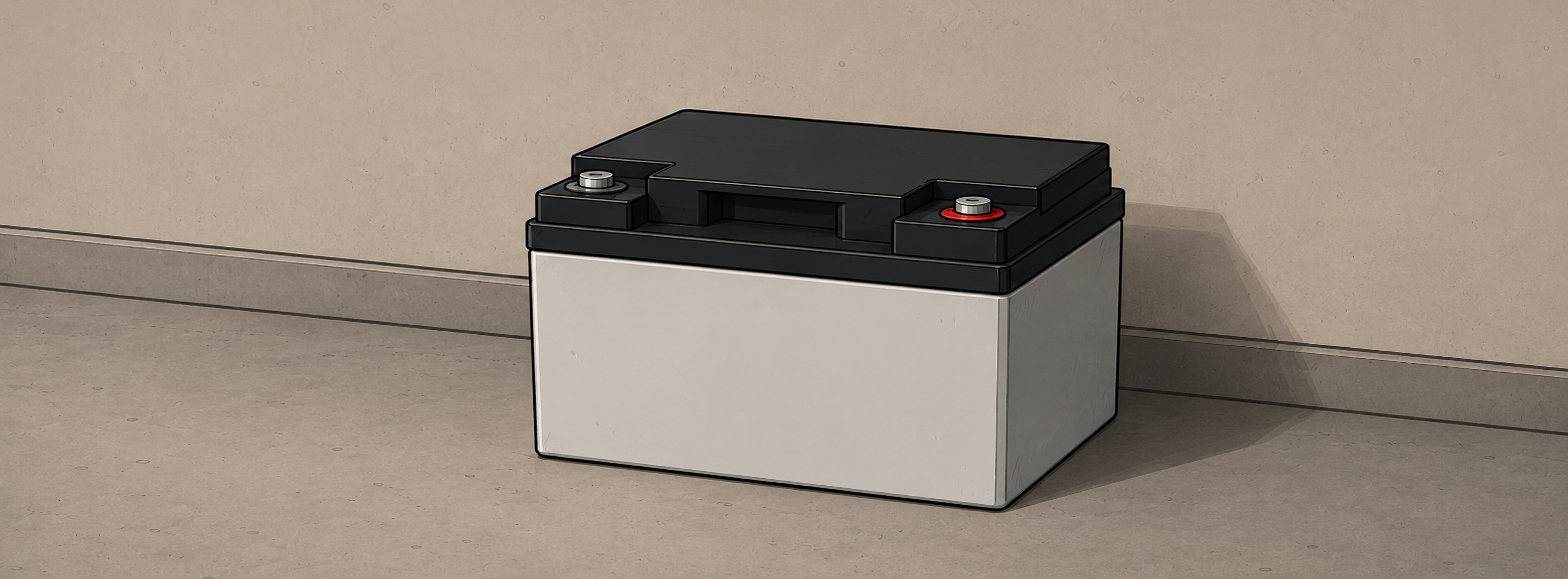 Shopping for a 50ah battery gets confusing fast. Multiple voltages, several chemistry types, and spec sheets full of numbers that don't explain themselves. This guide cuts through that. You'll learn what 50Ah actually means in practice, how the chemistry options differ, which voltage fits your setup, and what specs to check before buying.
Ah stands for amp-hours — how much current a battery can deliver over time. A 50ah battery can supply 50 amps for one hour, or 25 amps for two hours, and so on.
Total energy depends on voltage too:
A 12v 50ah battery and a 48V 50Ah battery share the same Ah rating — but the 48V model stores four times the energy. Knowing which voltage your system runs on is step one.
It's a mid-size capacity. Enough for overnight camping power, a trolling motor at moderate speed, or small solar backup. Not enough for whole-house outages or multi-day offshore trips with heavy electronics.
💡 If you need more run time, two 50Ah batteries wired in parallel give you 100Ah at the same voltage.
Most 50Ah batteries sold today are LiFePO4 (lithium iron phosphate). A smaller number are standard NMC lithium-ion, and some AGM lead-acid options remain. Here's how they compare:
A 50ah LiFePO4 battery lasts 5–10x longer than AGM and weighs about half as much. The cost per cycle works out far lower over time.
Note on self-discharge: at room temperature, LiFePO4 and AGM are actually similar — both around 2–3%/month. The real AGM disadvantage is cycle life and usable capacity, not storage behavior.
AGM still makes sense in one specific situation: charging below freezing without a battery heater. LiFePO4 cannot charge below 32°F unless the pack has a built-in self-heating circuit.
NMC lithium-ion appears mainly in 72V EV packs. Slightly higher energy density than LiFePO4, but less thermally stable — fine for high-voltage mobile applications, not the first choice for stationary storage.
The 12v 50ah battery fits systems already running on 12V: RV house banks, marine electronics, fish finders, and trolling motors.
At 80% depth of discharge, a 12v 50ah lithium battery gives you about 40Ah of usable power. Real-world runtimes at that usable capacity:
The 12v 50ah lithium ion battery and the 12v 50ah LiFePO4 battery look identical on the spec sheet. The difference is cycle life and safety — LiFePO4 wins both. The LiTime 12V 50Ah lithium battery for marine use is one well-regarded option, weighing just 11.57 lbs.
The 24v 50ah lithium battery stores 1,200Wh. Common in medium-sized solar systems, electric wheelchairs, and fishing kayak setups. A 24v 50ah lifepo4 battery runs the same chemistry benefits as its 12V counterpart — just at higher voltage.
The 36v 50ah lithium battery fits high-thrust trolling motors (55 lb and above) and some three-battery golf cart configurations. Also used in mid-sized solar setups where 24V is underpowered and 48V is overkill.
A 48v 50ah battery stores 2,400Wh. The 48v 50ah lithium battery and 48v 50ah lifepo4 battery are popular in stackable home energy storage, telecom stations, and larger off-grid systems. The Renogy 48V 50Ah Smart Lithium Iron Phosphate Battery includes Bluetooth monitoring and a self-heating function — useful for cold-climate installations. The 48v 50ah lithium ion battery shows up in some commercial equipment.
The 72v 50ah lithium battery is built for electric vehicles: e-bikes, scooters, and motorcycles running motors up to 3,000W. A 72v battery 3000w 50ah pack stores 3,600Wh. These are often sold as a 72v 50ah lithium battery kit with charger, BMS, and connectors included. A bare 72v 50ah battery is also available separately for custom pack builds. Chemistry here is often NMC, since its higher energy density matters more at this application than the extra cycle life of LiFePO4.
The 50Ah capacity works well across a wide range of applications — what changes the equation is voltage and chemistry. A 12v 50ah lithium battery handles most RV, marine, and small solar needs. Step up to 24V or 48V for larger solar setups or home backup. Choose 36V for high-thrust trolling motors, 72V for electric vehicles.
On chemistry: LiFePO4 is the right call for almost everyone. More cycles, lighter weight, and safer chemistry than AGM or NMC. AGM is worth considering only if you need to charge below freezing and can't justify a battery with a self-heating circuit.
💡 Check cycle life, BMS protections, and cold-temperature specs before you buy. A1 SolarStore carries a full range of 50Ah lithium batteries across all voltages — browse the catalog to find the right fit for your system.
Divide your device's amp draw into usable capacity. An 80% DoD on a 12V 50Ah LiFePO4 gives you 40Ah. A 10A load runs about 4 hours; a 2A load runs about 20 hours.
Yes. LiFePO4 batteries need a lithium-compatible charger — typically 14.2–14.6V absorption and 13.6V float for 12V models. A standard lead-acid charger can overcharge the cells and shorten battery life.
Yes. Two in parallel = 100Ah at the same voltage. Two in series = double the voltage (e.g., 24V from two 12V packs). Use the same brand, chemistry, and state of charge when connecting.
LiFePO4 is a type of lithium-ion. It runs more cycles and handles heat better than standard NMC lithium-ion. NMC packs more energy per pound — useful in space-constrained EV batteries — but it's more sensitive to overcharging and heat.
Most can, but check the product specs. Some manufacturers specify upright mounting only.
Going Fully Off-Grid: A Step-by-Step Sizing Guide with Briggs & Stratton Experts
New Solar Panel Tariffs Just Hit 173% on Asian Cells. One October Vote Decides What Happens Next
Why Doesn't Anyone Trust "Made in USA" Solar Anymore? Q2 2026 US Solar Market Insight
Solar Panel Maintenance 101: Cleaning, Inspection & Tips From a Tier 1 Manufacturer, Talesun
Stay tuned
Free and usefull digest on solar energy. No spam
 Energy Storage Systems (BESS & ESS)
 Forklift
 Golf Carts
 Home Backup
 Industrial & Commercial ESS
 Marine
 Medical Equipment
 Pallet Jack
 RV
 Scissor Lift
 Solar
 Tesla PowerWall Alternatives


